Category Archives: poetry

Do you DIY?

(names changed to protect the innocent)

Recently, my niece, Holly, made a black cat pinata from scratch for Halloween. Did you read that? A pinata FROM SCRATCH! She didn’t buy it at the Bulk Barn or Party City. She handmade it. What the?!

Of course, she captured and shared the step-by-step magic on Instagram. I marveled at it – her ingenuity, her patience. Hundreds and hundreds of confetti-like squares of black tissue paper individually glued to a perfectly carved cardboard cat frame. Her two seven-year old twin girls proudly helped along the way, gluing on the eyes, preparing the whiskers. Then they reveled in the moment they got to smash it with their friends – scrambling and shrieking for candy.

“Damn,” I thought. “She’s so talented, thoughtful and creative.”

Last June, when my daughter was graduating from high school, her friend’s mom, Leah, printed out pictures from each year of her daughter’s school life, hung them one by one down the hall from her daughter’s bedroom with streamers, so when she woke up that morning, she opened her door to a celebration of her life so far – all leading to a balloon and flower shrine in the living room adorned around her grade 12 graduation photo as her family stood around and cheered.

When my kid told me about it, I’m pretty sure I caught a sense of longing and sadness in her eyes, wishing she had such a mom.

And once again, I thought, “Damn. She’s so talented, thoughtful and creative.”

I tried crafts with my kids as they grew up. Mostly, I bought them kits and paints from Michaels or the Dollar store and let them do their thing. If you’ve seen my past attempts at painting or crafts, you’d understand. I just don’t have the DIY DNA.

But then, after I gave my daughter her graduation present, I realized I was being too hard on myself.

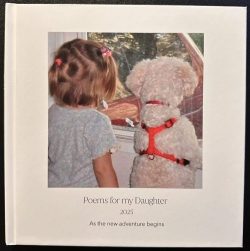
Poems for my daughter
My DIY book cover

I gave her a book of personal poems I had written about her to mark this significant transition in her life out of high school into university. Each piece was inspired by words I had collected about her from loved ones. At my request, they had sent me three words they think of when the think of her. I took them all and wrote some musings in hopes they would encourage, inspire, comfort or even spur a giggle from my youngest.

None of these poems came from a kit at Michaels or the Dollar Store. All of them came from me.

Tears ran down her cheeks as she read the pages. My heart filled.

That’s when I realized writing is my DIY, and damn, I am talented, thoughtful and creative!

I had created similar books for her two older sisters when they graduated. Each with their own twist, and their reactions equally filled my heart.

Over the years, I’ve written random poems and musings for many life moments for people I love: retirements, goodbyes, thoughts for a dying friend, my dad’s 90th birthday. I even did one for National Donut Day once. So fun! I do it because I love it and it means something to me. In turn, I also hope my words might mean something to others too – at the best of times, maybe they even get a laugh. (I’m no joke teller in real life, but sometimes I’m funny on paper 😊)

So, as it turns out, my DIY DNA isn’t half bad and I can hold my own against the likes of Holly and Leah.

Tell us how you DIY your writing and what it means to you.

1 Comment

Filed under Feel good, Inspiration, Life and stuff, Motivation, poetry, Trials and Tribulations

Cut loose

Exploring a tactile approach to poetry

April was declared National Poetry Month in the United States in 1996 by the Academy of American Poets. Likewise in Canada, in 1998, the League of Canadian Poets established April as National Poetry Month to bring together “schools, publishers, booksellers, literary organizations, libraries, communities and poets from across the country to celebrate poetry and its vital place in Canada’s culture.”

Here in Ontario, things feel less than celebratory at the moment. Winter is overstaying its welcome, the goings-on of our neighbours to the south are having an impact on us and around the world, a federal election is surfacing domestic challenges and fault lines, and the Great Pacific Garbage Patch is estimated to cover an area of about 1.6 million square kilometres. Yikes, to say the least.

Reading can feel like a wonderful escape right now. Poetry can, too. How lovely to dive into a Mary Oliver poem and feel at peace with the quiet majesty of geese, or trees, or grasshoppers. How tantalising to experience e.e. cummings’ thoughts on the body. How cerebral to spend a few hours (or a lifetime) investigating what William Carlos Williams meant by the red wheelbarrow in the rain.

Poetry is also political–a tool of resistance and protest. As the Editors of the Poetry Foundation have said, “Speaking truth to power remains a crucial role of the poet in the face of political and media rhetoric designed to obscure, manipulate, or worse.”

I have been exploring poetry myself recently, as both a reader and a writer. The world of poetry is vast and varied, and what I’ve read at school or in literary journals is a teensy fraction of all the poetic expression there is to enjoy.

And I want more.

As I continue my poetic education, I’ve decided to forget learning about the “important” poems. Forget about the canon, forget about the Norton anthologies. Instead, I’m reading poems published in The Walrus (like “Honey Crisp” by Molly Peacock). I’m reading poems tagged with #blueskypoets. I’m reading poems submitted to Poetry Week at CommuterLit where I’m a volunteer reader. I’m reading haikus, pantoums, sonnets, and so much more.

In my own poetic scribblings, I’ve been playing with words, imagery, and forms. I’ve written a poem about a spider crawling across my ceiling, a poem about a night out with my best friend, a poem about grapes. I’ve played around with book spine poems–and gotten the other Restless Writers trying it too (here’s Beckie’s, Andrea’s, and Sharon’s).

Something fun I did recently was cut words out of a magazine to create a collection of six-word poems, which I then consolidated into a single poem. I love how this activity is so accessible and exciting. It was tactile. Having my vocabulary limited to the words I had cut out forced me to find powerful and surprising creative combinations.

If you’re looking for a way to make poetry yourself, this exercise has a low barrier to entry. You can use any magazine–I chose the LCBO’s Food&Drink (natch). If you’re creating a book-spine poem, all you need is your own bookcase or a visit to the library. Play, celebrate! You don’t have to worry about being timeless, or cathartic, or insightful, or political. Those are all important aspects to poetry, and I will continue to strive to give my own poems that deeper dimension. But don’t let it stop you from the joyful act of playing with words to describe or illuminate your own experience of the world.

That’s how I’m celebrating this National Poetry Month. Will you join me?

Here’s the result of my experiment:

Armchair Adventurer
 
What flavour is beyond the world?
Meet the soul available for a game
A story about olives and wines
Pour your heart over the star flowers
 
Swap tomorrow to savour new time
Hop down the hour for escape
Drinking seconds by the loved road
Playing with plans for better madness
 
The blues feast at high showtime
Impressed by delights of happy sights
Scoop today – plan a great move
The active solution, a spirit choice
 
Travel to the layers of winter
Two views of the next west
Bench planning and start making sense
Explore the road under buzzing island
 
What has brought in your world?
We sip cocktails and taste culture
Our best pursuits are in adventures
Born yours with the unforgettable infinite

Maria Hypponen

Wishing you an inspiring National Poetry Month!

Maria

Leave a comment

Filed under Inspiration, poetry, Writing ideas

Today’s Poetic Prompt

This post is inspired by Maria. She has been writing up a storm these days and keeping us on our toes. A woman on a productivity mission! Maria prompted us back in May with her book spine poem, and I thought I’d give it a whirl.

The Island of the Day Before

Quiet, simple sabotage.

The gifts of imperfection:

illusions, nostalgia, pandemonium.

What’s left of me?

The dreamer.

Andrea, Sharon, I believe it’s your turn.

BJas

3 Comments

Filed under Inspiration, poetry

Wine, Space and a Cat Joke

My take on our poetry workshop

Maria wonderfully captured the poetry workshop we attended recently through the Burlington Public Library: Lynda Monk’s welcoming and positive approach; prompts that inspired our writing; our collective “affirmative noises” throughout the session.

Like Maria, I had also hesitated attending, but not for the same reasons. I don’t have a “prejudice against poetry”. I dabble from time to time and submitted my Your House is Not My House poem as pages for a Restless Writers meeting not that long ago. I also don’t hate journalling. While I may not journal every day, I am an “out loud” thinker, and when no one wants to listen, my journal pages are always willing.

I hesitated to participate because my brain prefers the ordinary. On the evening in questions, she said, “You’ve worked a long day. You’re tired. Wouldn’t you rather settle in to a night of watching Derry Girls episodes? Plus, you’ll have to do the dishes if Maria is coming over.”

But Maria had texted and offered to bring wine. So, what was I going to do? Say no? That’s funny. And I’m glad she did – come over, I mean. Not just bring the wine. (That said, Riesling on a Tuesday evening is a nice treat.)

For me, the gift of Lynda’s workshop was allowing in quiet and connection. It was a needed opportunity to tell my work and home brains to take 60, go commiserate about me over their own glasses of wine, and let me enjoy mine.

Lynda talked about how visceral poetry is. That it cuts to the essence, reveals the unspoken and digs into the senses. She shared this quote by Allen Ginsberg, “Poetry slows me down and brings me back to myself.” For me, on that Tuesday, I didn’t realize how fast I’d been moving until I followed Lynda’s instruction to close my eyes, listen to her recite Mary Oliver’s Wild Geese poem and write down any words or lines that stood out to us. That’s when I felt my breath deepen, and my body settle into her voice as I became drawn in by the verse.

And in that open space, she invited us to paint our own pictures through the prompts she provided. “I dwell in the possibility of…” “Silence is like…” or to fill in the blanks, using Jane Kenyon’s Otherwise poem as a template. Some participants chose to share what had sprung up in their writing. Usually, I’m one of them, but on this night, I was with the others who chose to simply listen and absorb.

To me, poetry is about presence and play. Experiencing it and then toying with the words, the shapes, the sounds, the spaces. You can choose the structure of a haiku or dance freely with your own use of the page, colour, fonts.

Toward the end, Lynda summarized our experience in the “5 Things to Practice to Free Your Inner Poet”:

  1. Breathing
  2. Stillness
  3. Listening
  4. Receiving
  5. Giving

These were the reminders I forgot I needed. Through this workshop, I expanded and found new creative energy. Maria opened up her imagination.

I encourage you to give yourself the gift of a writing workshop. Many are free or inexpensive and offered by local libraries or authors looking to inspire other writers. Maybe pick one that isn’t in your usual wheelhouse. You can certainly take one alone, or better yet, invite a fellow writer who never comes empty handed.

When it was done, Maria and I shared what had resonated with us from the workshop. We also shared some of our own verses inspired by the prompts. Maria, who is skilled at bringing levity to the heavy, wrote a a melancholy piece about a solitary meal, mixed with a little gratitude for her cat.

“The cat and I ate dinner,” she recited stone faced. “Not the same dinner. We both had tuna.”

I burst out laughing at her unexpected ending. Maybe you had to be there, but it was hilarious and one of the highlights of the evening! After finding a tissue to wipe my tears, and saying goodbye to Maria, I pondered what may be my next poem: I dwell in the possibility of wine with a friend.

Cheers!

Leave a comment

Filed under Inspiration, Motivation, poetry, Writing ideas, Writing resources

The possibility of poetry

Fellow Restless Writer Andrea and I had signed up to attend a virtual workshop hosted by our local library called “Prompts to Find Your Inner Poet.” I almost didn’t join in, for two reasons: one, I am still working to get over my prejudice against poetry; and two, the workshop was being led by Lynda Monk, a coach, speaker, facilitator, and author who is passionate about journalling – and I hate journalling. (Raise your hand if you’ve ever felt traumatized by Julia Cameron and her morning pages.)

Fortunately, I gave myself a rousing pep talk, convinced myself that it was only for an hour, grabbed a bottle of wine, and headed over to Andrea’s house, so we could attend online together.

The workshop, held last week, was well attended – about 35 people – and Lynda gave a gracious, welcoming, and warm introduction to the workshop. She told us there would be writing exercises (which I was eager to dig into) and that “we are all poets in some way.”

If I had expected the event to be cringey, it wasn’t. Lynda opened by asking us to reflect on “what is poetry?” She described a type of literary expression that is resonant, captures beauty and emotion, helps us feel “aliveness” and connection, and speaks to the “unspoken”: the “spaces in between and around experiences, thoughts and feelings.” She outlined a plain language understanding of poetry that was immediately accessible.

Lynda shared one of her favourite poems – “Wild Geese” by Mary Oliver – and asked us to reflect on what stood out for us in the poem. A word, a phrase, a feeling? She shared that the poem evoked a sense of quiet, and that everyone needs to be able to access that kind of quiet in order to write.

She returned to this concept later in the session when she talked about the white space on one of the presentation slides. “Our creative selves need white space, where we can recognize what we have within our hearts to say.”

Throughout the session, Andrea and I would make little affirmative noises in response to some piece of insight that Lynda shared about poetic language. I found Lynda’s approach to talking about poetry, and encouraging each of us to explore new poetic prompts, to be the opposite of cringey. She was engaging, positive, non-critical, practical, and inclusive.

One takeaway for me was what Lynda had to say about the transformative effects of poetry. To paraphrase, poetic writing can transform what we’re feeling into something else (e.g. writing about a negative experience can turn it into a positive one), and poetic writing can transform ourselves, by altering our perceptions about our own experiences and emotions.

The writing exercises were intriguing and fun – Andrea and I agreed we should share the prompts at a future Restless Writers’ meeting.

  • Take the first line of your favourite poem, and use it as a prompt for your own poem. Lynda used Emily Dickinson’s “I dwell in Possibility” as the line prompt.
  • Use the structure of an existing poem as a template for your poem. “Otherwise” by Jane Kenyon was the perfect prompt to have us imagining our own alternate lives.
  • Cut words out of a magazine or newspaper, and paste them into poems in different shapes. (Ahem, an idea for the next Restless Writers’ holiday craft night?)
  • Create a “book spine poem.” This was another exercise Lynda encouraged us to try on our own time – you take books from your shelves, and make a poem out of their titles. Mine is below.

Principles still missing.
How did that happen?
The novel cure underland, surrounded by idiots, sediment in streams.
Do not disturb the big thing.

I’m thankful I talked myself into joining the workshop, and I’m thankful for Lynda’s generous and gentle approach. It opened up something in my imagination and in my writing that I might have been repressing. I’m looking forward to exploring more poetic writing this spring.

Maybe I’ll even give journalling another go. But no promises.

Which of the poetic prompts above will you try?

Maria

PS: Learn more about Lynda here.

7 Comments

Filed under Inspiration, poetry

Submissions now open for 2016 Walrus Poetry Prize

photo-1457298483369-0a95d2b17fcdThe Restless Writers have just learned that submissions are now open for the 2016 Walrus Poetry Prize.

The Walrus Foundation announced today that the fifth annual Walrus Poetry Prize will be judged by The Walrus poetry editor Damian Rogers and celebrated poet Hoa Nguyen. The Hal Jackman Foundation generously supports this $5,000 prize.

Submissions will be received between August 5 and September 12, and Rogers will narrow them down to a short list of five poems. Nguyen will be tasked with selecting the $,4000 winner. (No pressure!)

The five finalists will be revealed online on October 3, where readers can vote on their favourite poem until October 26. The Readers’ Choice winner will receive $1,000.

Both poems will appear in the January/February 2017 issue of The Walrus, at http://thewalrus.ca, and in the Poetry in Voice anthology.

Information at a glance:

Submissions open: August 5 – September 12
Shortlist announced: October 3
Vote for the Readers’ Choice Award: October 3 – October 26
Winners announced: December 6
Entry fee: $25

For more information—including eligibility requirements, rights and how to submit, visit http://thewalrus.ca/poetry-prize.

Even if you don’t submit a poem, please be sure to vote for the Readers’ Choice winner.

Good luck to all!

Maria

1 Comment

Filed under Awards and contests, poetry

Tread gently: Some tips for critiquing poetry

photo-1429032021766-c6a53949594f“Poetry is when an emotion has found its thought and the thought has found words.”
~ Robert Frost

The Restless Writers are a diverse bunch. Our interests range from children’s picture books and YA to memoir to spoken word. Recently, a few of our members have even ventured into poetry. And while we as a group are supportive of all our individual efforts–even if we haven’t had a lot of experience with a particular genre–we are not all confident in our ability to critique poetry.

I have a graduate degree in English literature, so you’d think I would have some skills when it comes to reading a poem and giving feedback to help the poet better express her idea. But my university years are well–well!–past, so I have been trying to find ways that I can offer feedback in a constructive way. Because with our writing group, it’s all about trying to make each other better writers.

Poetry doesn’t appeal to everyone, and you might not get or even appreciate each poem you read. But hopefully my approach to critiquing a poem will help you give positive and constructive feedback to the poet in your group.

Immediate impact: 
The first thing I reflect on when I read a poem is how it makes me feel when I read it for the first time. I try not to get bogged down in the structure or form of the poem at this stage–I let the words and rhythm carry me through. Does my mind delight in the poet’s language? Does she make me think about an object, an experience, a setting in a new way? Do I smile involuntarily because of the way she described a particular moment? Can I relate to the subject? Is it uniquely personal or oddly universal? How did her poem touch me, on an emotional or intellectual level?

Dig a little deeper:
Next, I think about how the poet achieved these impacts. How did she use language and metaphor to evoke a specific mood? How did she structure the poem? Did she employ a specific form, and was she true to the spirit of that form? Was she consistent in her use of meter and rhyme? How did structure and form help to emphasize different elements of her poem? Where could she have used such devices to better effect? How did she use words and sounds to jar, to charm, to tease, or to question? The important thing at this stage is to be honest but respectful, and tread gently.

Move forward:
To wrap up my critique, I provide suggestions regarding word usage, punctuation, and spelling. If I found some phrases to be a little clichéd, I try to help her come up with some fresher or more surprising options. If I really liked a particular stanza or rhyme, I let her know that too. I also like to find out what she wants to do with the poem. Is it a stand-alone piece that she wants to submit to a journal? Or will it be part of a larger work or series of works? Perhaps she wants to read it at an event or gathering, or keep it all to herself. Whatever she wants to achieve, I offer to do a second reading before she considers it done.

I always bring my own emotional state and life context to each poem I read. Different poems with different subjects will have different impacts on me, depending on what is happening in my life at the time of reading. But I think that’s one of the beautiful things about poetry–it can create an intimate connection between the poet and the reader, using language as a bridge. And for the Restless Writers, poetry is just another way we get to explore the ideas, themes, and words that keep us writing.

Happy critiquing!

Maria

2 Comments

Filed under Group meetings, poetry

Spread the Light

Do you like to write poetry? Are you on Twitter?

Consider joining in a collaborative Twitter poem Wednesday June 20, 8 – 10 pm EST, in celebration of the solstice. The theme, naturally, is Light.

How does this copoem work? Simply get on Twitter and tweet a line or two of original poetry. Make sure to include the hashtag keyword #copoem in your tweet so it doesn’t get lost. (If you search using the hashtag key you will be able to see what others have written too.)

Afterwards, the tweets will be gathered and stitched together – perhaps with an edit or two – and the final poem will be posted at www.karenkachra.com. Who knows what we’ll come up with…it’s an experiment!

Thanks to Tara T. @tara_in_canada for this fun idea and Karen Kachra @karenkachra for organizing everything!

Happy Solstice,
The Restless Writers

ls

Leave a comment

Filed under Author events, Calls for submissions, Inspiration, poetry, Writing ideas, Writing resources

And the powerful play goes on

Today is the birthday of the great American poet Walt Whitman. Controversial from the moment he self-published Leaves of Grass, Whitman has been maligned as immoral, perverse, sacrilegious and decadent. But he is also praised as the poet of democracy, the father of free verse, and possibly the first Beat poet.

I like to think of him as one of the original restless writers—in addition to writing, he made a living as a typesetter, a clerk, a teacher, a journalist and a nurse. “Do I contradict myself?” he once said. “Very well, then I contradict myself, I am large, I contain multitudes.”

The question, O me! so sad, recurring—What good amid these, O me, O life?
            Answer.
That you are here—that life exists, and identity;
That the powerful play goes on, and you will contribute a verse.

                                                                                                 From O Me! O life!

Maria

1 Comment

Filed under poetry

Overcoming my “prejudice against poetry”

I had a wonderful meeting with the other two winners of the BPL all-night short story contest over the weekend. Karen Kachra, Jennifer Mook-Sang, and I met up at CJ’s Café in Bronte to get to know each other and read our prize-winning stories. (Which were lovely, by the way! I’m looking forward to reading more of their work in the future.)

We chatted about what we liked to read for pleasure, and Karen mentioned feeling like she had a bit of a “prejudice against poetry”. (Love that phrase, Karen!)

The three of us agreed that poetry made us feel a bit dense. We expect it to be full of symbolism and deep thoughts and references that we just won’t get. Poetry seems like a lot of work.

Being required to take a graduate seminar on the long poem (think T.S. Eliot and Ezra Pound) during one dark, Montreal winter may have ruined me for poetry. By that time, I had already finished my undergraduate degree in English Literature and published a few poems—I had had my fill.

Ten-plus years later, and I still generally skip the poetry in the literary journals I read. I’m drawn to the stories, the dialogue, the action.

But every once in a while, I’ll catch a word or a phrase in one of the poems I’m passing over—“violet night”, “vainglorious”, “this gritty pearl”—and sigh over the sensual power of language. I remember being amazed, way back when, by how poets more than anyone else get to play with words and use them in surprising ways to elicit emotional reactions.

It’s time I started reading poetry again. I’m looking for recommendations to help me get over my poetry prejudice. Jennifer and Karen recommended Billy Collins. Any others I should check out?

Maria

3 Comments

Filed under poetry