Tag Archives: writing

Do you DIY?

(names changed to protect the innocent)

Recently, my niece, Holly, made a black cat pinata from scratch for Halloween. Did you read that? A pinata FROM SCRATCH! She didn’t buy it at the Bulk Barn or Party City. She handmade it. What the?!

Of course, she captured and shared the step-by-step magic on Instagram. I marveled at it – her ingenuity, her patience. Hundreds and hundreds of confetti-like squares of black tissue paper individually glued to a perfectly carved cardboard cat frame. Her two seven-year old twin girls proudly helped along the way, gluing on the eyes, preparing the whiskers. Then they reveled in the moment they got to smash it with their friends – scrambling and shrieking for candy.

“Damn,” I thought. “She’s so talented, thoughtful and creative.”

Last June, when my daughter was graduating from high school, her friend’s mom, Leah, printed out pictures from each year of her daughter’s school life, hung them one by one down the hall from her daughter’s bedroom with streamers, so when she woke up that morning, she opened her door to a celebration of her life so far – all leading to a balloon and flower shrine in the living room adorned around her grade 12 graduation photo as her family stood around and cheered.

When my kid told me about it, I’m pretty sure I caught a sense of longing and sadness in her eyes, wishing she had such a mom.

And once again, I thought, “Damn. She’s so talented, thoughtful and creative.”

I tried crafts with my kids as they grew up. Mostly, I bought them kits and paints from Michaels or the Dollar store and let them do their thing. If you’ve seen my past attempts at painting or crafts, you’d understand. I just don’t have the DIY DNA.

But then, after I gave my daughter her graduation present, I realized I was being too hard on myself.

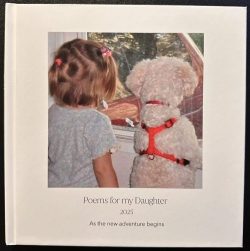
Poems for my daughter
My DIY book cover

I gave her a book of personal poems I had written about her to mark this significant transition in her life out of high school into university. Each piece was inspired by words I had collected about her from loved ones. At my request, they had sent me three words they think of when the think of her. I took them all and wrote some musings in hopes they would encourage, inspire, comfort or even spur a giggle from my youngest.

None of these poems came from a kit at Michaels or the Dollar Store. All of them came from me.

Tears ran down her cheeks as she read the pages. My heart filled.

That’s when I realized writing is my DIY, and damn, I am talented, thoughtful and creative!

I had created similar books for her two older sisters when they graduated. Each with their own twist, and their reactions equally filled my heart.

Over the years, I’ve written random poems and musings for many life moments for people I love: retirements, goodbyes, thoughts for a dying friend, my dad’s 90th birthday. I even did one for National Donut Day once. So fun! I do it because I love it and it means something to me. In turn, I also hope my words might mean something to others too – at the best of times, maybe they even get a laugh. (I’m no joke teller in real life, but sometimes I’m funny on paper 😊)

So, as it turns out, my DIY DNA isn’t half bad and I can hold my own against the likes of Holly and Leah.

Tell us how you DIY your writing and what it means to you.

1 Comment

Filed under Feel good, Inspiration, Life and stuff, Motivation, poetry, Trials and Tribulations

No research, no outline, no problems

Confession: When Maria and Beckie first invited me to be part of Restless Writers, I put them off. I was working full time. My kids were young. I wouldn’t be able to fit in one more thing…

I had no shortage of excuses to cover up the truth which was, I was scared I wasn’t good enough. I had very specific things in my mind about what a writer should be. They are someone who carefully crafts an outline, mapping out their entire novel before ever putting a word on a page. More than likely, they are someone who hops on a plane to learn more about a locale central to their story. Or one who interviews a veteran detective to get inside the mind of their main character. These were not things I was doing. I was just winging it.

Photo by cottonbro studio on Pexels.com

While I eventually took the leap and joined our merry band of RWs, that annoying doubt that I didn’t have the discipline to be a true writer lived on. It’s firmly planted on my shoulder, in a tiny little critic who begins chirping any time I sit down to draft a new chapter or consider a new project. “This is not going to work. Do you think a real published author would write a book without knowing where the story is going?” And on it goes.

So, you can imagine my satisfaction, and delight, when I recently discovered, that yes — yes, they absolutely would.

Earlier this summer, I took part in an author talk featuring the New York Times best-selling author Lisa Jewell. The webinar, Explore the Unexpected Twists and Turns with Lisa Jewell, was hosted by the Library Speakers Consortium, in partnership with my local library. The Consortium livestreams events every month featuring best-selling authors. Each event includes an interactive Q&A session and is recorded.

Throughout the hour-long webinar, Lisa shared a lot of valuable behind-the-scenes insights about her work and writing process, but two things really stood out and had me feeling freed of my own writerly expectations.

No research

During the event, Lisa explained she doesn’t choose subjects for her books where research is needed. Fans of the 23 psychological thrillers she’s written will know many of her books tend to focus on domestic drama. This is intentional:

I’m a very domestic person. I live in a tiny bubble, and I like to only kind of know about things that are close to me. My home, my children, my animals, my friends, my plans, my life. Obviously, I co-exist in the world with all the big things that are happening, but when it comes to my main focus… I want to understand about the small things happening to small people, small lives that are blown apart by tiny events that nobody could have foreseen happening.

Did you hear that little critic?!

I don’t like researching, so the idea of writing about like… financial markets, or police procedure, or espionage… I don’t know how those things work, and I don’t really have any interest in learning about how those things work. So, I like to stick to the territory that I’m familiar with and fascinated by.

While she has respect for authors that ground their writing in research, it is not part of her process.

… There are so many authors who are just so different to me, and they consider that to be part of their job. They can’t start writing a novel until they’ve spent weeks, months making phone calls, doing site visits, reading books… whereas me, literally, ‘okay, I’ve got to start writing my book today’ and I just start typing…

No outline

And guess what? She skips the outlining stage too!

While she has a very clear image of the first chapter, Lisa says she typically has no plan of where the story will go, from chapter to chapter:

I can’t write a book, or can’t plot a book, or think about a book, or do anything about a book anywhere apart from inside my head or inside the manuscript… Post-it Notes, white boards – those things don’t work for me. I wouldn’t know what to do with them.

🤯

No problems

With every passing minute of the webinar, I could feel the little critic on my shoulder getting quieter. Am I a functioning adult who fully understands there is more than one way to approach most things in life? Absolutely. But was it still incredibly validating to hear a beloved writer say that a no-research, no-outline process can not only work but also lead to real success? Heck, yes! It was a much-needed reminder that writing is an art, not a science—and that I need to trust my instincts more and care less about how others may perceive my process.

If you’re curious to hear more of Lisa’s insights—including her thoughts on leap-frogging genres and why she believes the epilogue is the most important part of a novel—you can catch her full webinar through Library Speakers. You can also check out upcoming events.

Leave a comment

Filed under Uncategorized

Cut loose

Exploring a tactile approach to poetry

April was declared National Poetry Month in the United States in 1996 by the Academy of American Poets. Likewise in Canada, in 1998, the League of Canadian Poets established April as National Poetry Month to bring together “schools, publishers, booksellers, literary organizations, libraries, communities and poets from across the country to celebrate poetry and its vital place in Canada’s culture.”

Here in Ontario, things feel less than celebratory at the moment. Winter is overstaying its welcome, the goings-on of our neighbours to the south are having an impact on us and around the world, a federal election is surfacing domestic challenges and fault lines, and the Great Pacific Garbage Patch is estimated to cover an area of about 1.6 million square kilometres. Yikes, to say the least.

Reading can feel like a wonderful escape right now. Poetry can, too. How lovely to dive into a Mary Oliver poem and feel at peace with the quiet majesty of geese, or trees, or grasshoppers. How tantalising to experience e.e. cummings’ thoughts on the body. How cerebral to spend a few hours (or a lifetime) investigating what William Carlos Williams meant by the red wheelbarrow in the rain.

Poetry is also political–a tool of resistance and protest. As the Editors of the Poetry Foundation have said, “Speaking truth to power remains a crucial role of the poet in the face of political and media rhetoric designed to obscure, manipulate, or worse.”

I have been exploring poetry myself recently, as both a reader and a writer. The world of poetry is vast and varied, and what I’ve read at school or in literary journals is a teensy fraction of all the poetic expression there is to enjoy.

And I want more.

As I continue my poetic education, I’ve decided to forget learning about the “important” poems. Forget about the canon, forget about the Norton anthologies. Instead, I’m reading poems published in The Walrus (like “Honey Crisp” by Molly Peacock). I’m reading poems tagged with #blueskypoets. I’m reading poems submitted to Poetry Week at CommuterLit where I’m a volunteer reader. I’m reading haikus, pantoums, sonnets, and so much more.

In my own poetic scribblings, I’ve been playing with words, imagery, and forms. I’ve written a poem about a spider crawling across my ceiling, a poem about a night out with my best friend, a poem about grapes. I’ve played around with book spine poems–and gotten the other Restless Writers trying it too (here’s Beckie’s, Andrea’s, and Sharon’s).

Something fun I did recently was cut words out of a magazine to create a collection of six-word poems, which I then consolidated into a single poem. I love how this activity is so accessible and exciting. It was tactile. Having my vocabulary limited to the words I had cut out forced me to find powerful and surprising creative combinations.

If you’re looking for a way to make poetry yourself, this exercise has a low barrier to entry. You can use any magazine–I chose the LCBO’s Food&Drink (natch). If you’re creating a book-spine poem, all you need is your own bookcase or a visit to the library. Play, celebrate! You don’t have to worry about being timeless, or cathartic, or insightful, or political. Those are all important aspects to poetry, and I will continue to strive to give my own poems that deeper dimension. But don’t let it stop you from the joyful act of playing with words to describe or illuminate your own experience of the world.

That’s how I’m celebrating this National Poetry Month. Will you join me?

Here’s the result of my experiment:

Armchair Adventurer
 
What flavour is beyond the world?
Meet the soul available for a game
A story about olives and wines
Pour your heart over the star flowers
 
Swap tomorrow to savour new time
Hop down the hour for escape
Drinking seconds by the loved road
Playing with plans for better madness
 
The blues feast at high showtime
Impressed by delights of happy sights
Scoop today – plan a great move
The active solution, a spirit choice
 
Travel to the layers of winter
Two views of the next west
Bench planning and start making sense
Explore the road under buzzing island
 
What has brought in your world?
We sip cocktails and taste culture
Our best pursuits are in adventures
Born yours with the unforgettable infinite

Maria Hypponen

Wishing you an inspiring National Poetry Month!

Maria

Leave a comment

Filed under Inspiration, poetry, Writing ideas

A meditation in three words

I have some big creative plans for 2025.

I’m working on a short story collection, with a goal of drafting one story every month. The Restless Writers are working on a collaborative project – which Beckie mentioned a few months ago – that will have a lot of moving parts and ambitious deadlines. I have a new non-fiction project waiting in the wings, as well as some non-writing related plans too.

I’m excited to work towards my goals, and they’re important to me. But like a lot of the world, I feel like I’m teetering on the edge of chaos. How can I intentionally create space for pursuing my writing when it feels like I’m losing control? How can I keep moving forward when the work feels like I’m swimming through molasses? How can I support my creative and mental health in an already full and hectic life?

What helps me is a three-word mantra: Discipline. Patience. Joy.

Here’s what these words mean to me.

Discipline

I’ve come to accept that, for me, a daily writing habit isn’t realistic. I have a full-time job and do freelance work on the side, so it’s not feasible to find an hour to write every single day. What I can do is plan writing blocks in my weekly schedule when it makes sense for me. Sunday mornings, for example, work very well. Mini-DIY writing retreats are another tool I use. The discipline part kicks in when I commit to those writing blocks or retreats and use my writing time effectively.

(Not a write-every-day person? Feel better about it with the idea of “binge writing,” which I learned from Allison K Williams in this blog post.)

Showing up for other people is another part of my creative discipline. The monthly(ish) Restless Writers meetings are a big part of that. I also offer support to a small circle of people who are working towards creative goals and need the help of an accountability partner. When I show up to co-work with them, I’m also showing up for myself.

Most days, I struggle with focus. And there’s nothing like the fidgets to disrupt one’s creative efforts. So, this year, I’m banning the disruptors – those things that pull me out of creative flow. I’ve deleted TikTok (which I should have done eons ago, honestly). I’ve muted social media notifications. I’ve silenced the siren call of books to be read and jigsaw puzzles to be completed by moving them to a different room. Out of sight, out of temptation, right?

I’ve also taken steps to make it as easy as possible to transition into writing mode. Check out my previous posts about creative readiness (part 1 and part 2) if you want to hear how I’m setting myself up for creative success.

Patience

Where the word discipline feels somewhat sterile and harsh, patience feels like grace.

Creative work takes time, especially if you’re pursuing bigger goals, like a novel. With generative AI all around us, promising instant creative gratification, it can be hard to pull on the reins and settle into a rhythm of doing the time-consuming work. I have to remind myself that my writing goals won’t be achieved in one day – or heck, even in one week – and that’s okay. My slow and bumbling human brain is creating worlds, inventing people, and imagining love and disaster. Isn’t that beautiful?

Patience is also about knowing that my creative work will be there even if I have to step away from it. Life happens, and you might experience things that throw you off your creative game. I’ve had some setbacks already this year. Work got busy early. I had a monster freelance project that never seemed to end. The US election results gave me creeping, swirling, can’t-sleep-at-night anxiety. And last week, I said goodbye to my darling tortoiseshell cat, Mary Piper, who had been my companion for the last 14 years. Today was the first day I’ve felt like getting back to my writing. And you know what? The creative spark and the drive were still there. The story still called to me. So, I poured a coffee, put on some focus music, and got back to it.

This is Mary Piper, and one of her gazillion toys.

Joy

The third facet of my mantra is a gift to my creative self, a way of refilling my well and helping me feel connected to people and beauty around me. Frankly, joy has been hard to come by recently. There’s a lot going on – in my life, in the world – that makes joy seem elusive, like a shy fox in winter, or a sunrise hiding behind the morning fog. It can also be hard to recognize joy when you crash into it.

For me, joy feels like the hum of creative connection, the quiet of being immersed in nature, the exhilaration of moving my body, and the pleasure of interacting with art.

This year, I’m making the experience of joy a proactive exercise.

I’m seeking out and attending events, like an author reading at the library or an Alice in Wonderful exhibit at the Royal Botanical Gardens. I’m waking up early and walking to the frozen and glorious lake. Those books and puzzles I relegated to another room for the sake of discipline? I’m savouring them when I’ve finished my writing for the day. These moments are me welcoming and pursuing joy in my everyday life.

Discipline. Patience. Joy.

I breathe deeply and hold these words in my consciousness as I get ready in the morning. I contemplate them, written on the whiteboard in my study, throughout the day. I whisper them to myself when I get frustrated or depleted or sad. I re-visit them at night, to remind myself that I’m nurturing my creative self in ways that work best for me.

Do you have a mantra or a special word for 2025? I’d love to hear what it is and what it means to you.

Maria

2 Comments

Filed under Life and stuff, Motivation, Trials and Tribulations

Are you a starter or a finisher?

The Restless Writers have just returned from our annual writing retreat. It was filled with stories of true confession, a lightning round of Trivial Pursuit (Canadian edition), a birthday party with Sparkling Stars, beaucoup prompts, a new word (deliciate: to indulge and make yourself happy), and…something very special.

We’ve been working on a collaborative project for a couple years now that we’ve finally committed to finishing—and launching in the Spring of 2025. You heard it here! It’s a project we’ve been weaving together that commemorates our sixteen year friendship. Our hope for the project is it will allow us to support and celebrate writers on a similar journey to ours. Writers helping writers.

Like any creative project, it’s been a challenge to keep it moving forward. Each one of us brings a different productivity persona to the table. Meaning, a couple of us live for the creative beginnings of a new project and a couple of us are eager to execute! Lucky for us, we’re the perfect combination of ideas, plans, skills, and whimsy. We can do this, and we will.

As writers, we have always approached our individual creative journeys differently. We daydream. We abandon. And when it feels right, we give life to those ideas that tug on our shirt sleeves and keep us up at night. We live for these moments! Some projects completed, some published, some still living in notebooks and on USB keys, enduring edit after edit. And that’s okay. It allows us the freedom and flexibility as writers to use the right approach for the job, and at the time when it suits us.

We’re starters. We’re finishers. And we need each other. For encouragement, for accountability, and for butter tart runs to the farm. These are just a few of the things that make us a badass writing team. More to come on our pet project.

Do you consider yourself a starter or a finisher or somewhere in the middle? Tell us more in the comments.

1 Comment

Filed under Blogging, Feel good, Group meetings, Inspiration, Motivation, Writing ideas

Unprompt Prompt

If you’ve been following along here for the last few months, you’ll know the Restless Writers have been sharing some original works in the form of a book spine poem. Maria kicked things off, with Beckie and Andrea following close behind. Today, bringing up the rear, is yours truly.

To create my book spine poem, I headed to our neighbourhood Little Library for some inspiration. By the way, can we just take a moment to talk about the goodness that Little Libraries are in this zany world?! Thank you.

It was especially fun to explore the new-to-me titles that included some unexpected gems. So, without further ado, I bring you the final entry in the Restless Writers’ book spine poem series – Who Moved My Cheese?

Who Moved My Cheese?

Bright, from the start.
A walk across the sun.
Stories of your life and others.
Chasing grace.
Who moved my cheese?

1 Comment

Filed under Uncategorized

Today’s Poetic Prompt

This post is inspired by Maria. She has been writing up a storm these days and keeping us on our toes. A woman on a productivity mission! Maria prompted us back in May with her book spine poem, and I thought I’d give it a whirl.

The Island of the Day Before

Quiet, simple sabotage.

The gifts of imperfection:

illusions, nostalgia, pandemonium.

What’s left of me?

The dreamer.

Andrea, Sharon, I believe it’s your turn.

BJas

3 Comments

Filed under Inspiration, poetry

Building creative readiness – Part 1: Your physical environment

According to celebrated author and performer Ivan Coyote, “You have to be actively engaged in the creative practice for the creativity to hit you” (Globe & Mail, August 7, 2023). They credit self-disciple, nature walks, and hot showers to their success. Coyote strongly believes that you have to put in the work to be prepared to be creative. That way, you’re ready when inspiration hits.

I think of this as creative readiness – an intentional way of removing any friction between you and your writing practice. It’s an approach that clears out the excuses and signals to your creative muscles that it’s time to write.

Creative readiness has two dimensions: your physical writing environment and your creative mindset. Being prepared to be creative means shoring up both of these dimensions. In practice, creative readiness is a series of individualized actions or processes that mark the transition into writing mode, and a way of preparing yourself mentally to make that transition.

I wondered what other writers thought about creative readiness, so I asked my fellow Restless Writers to weigh in. They had a lot to say – so much in fact, that I’m splitting this blog post into two parts.

In this first part, let’s dig into how the Restless Writers set up their physical environments to work on their creative tasks.

Space to let the words flow

A writer needs space. A place to build worlds, invent characters, concoct plots, converse with their muse, and do battle with their inner critic. Virginia Woolf famously said that women writers needed “a room of one’s own” (literal and metaphorical) in which to write. Ray Bradbury wrote his first novel on a typewriter he rented for ten cents an hour in the basement of UCLA’s Lawrence Clark Powell Library. Edith Wharton wrote from her bed.

I asked AI to create an image of the perfect writer’s office. Here’s the result:

I mean… That looks pretty perfect to me. (The Edison lights and cosy blanket? Love those details!)

In reality, there is no universal “perfect” writing space – it is personal to each writer.

Beckie, a Restless Writer with an enviable backyard, has a dedicated writing shed – but it’s weather-dependent. “Ideally, I write in my writing shed. This works best because there are no distractions, except weather at times when it can get too hot or too chilly. I dream of a mini woodstove in there, with space for a tea pot.” When the shed isn’t an option, she makes do with her dining room table. Beckie is currently editing a memoir.

Cute shed, Beckie!

Andrea has a self-described “backyard oasis” at her home, complete with multiple writing spots and a pool if she needs an active break. Her space is weather-dependent as well. If she’s forced inside, she opts for the living room couch. Wherever she is, she needs a bit of nature. “I look for a spot that is comfortable and full of light; under trees, or where I can see them.”

Staying mobile means Andrea is ready to write when inspiration hits. Sharon, who’s working on a mystery/thriller novel, likes to mix up her writing spots too. “I usually write sitting up in bed against the headboard with my laptop on my lap (obviously) and my notes spread out around me,” she says. “If I’m at the library, I go for the comfiest chair I can find.” Sharon finds sitting at a desk to be too formal.

Like Beckie, I have a writing space all to myself, but it’s also my home office. I have a work-from-home day job, so my 9-to-5 is the same space as my 5-to-9. On the plus side, a dedicated office means I don’t have to fight for space or negotiate with family members for a little quiet time. There’s room enough for my books, writing supplies, files, and two desks. I can close the door and focus on my work whenever I want.

My creative readiness struggle is transitioning from work-Maria to creative-Maria without physically leaving my office. I’ve started to venture out of my formal office and – like Beckie – set up on the dining room table so I can step purposefully into the writing zone.

Technology, talismans, and snacks

The physical writing space includes all the things we need around us to write. That can look different for everyone, but the basic categories are writing implements/technology, writing supports, sustenance, and ambiance.

Sharon gets back to basics when she writes. “I’ve usually got a glass of water beside me on the nightstand and a little bowl of some nibblies – M&Ms, almonds, chips, they all work. I’ve always got the outline for my novel nearby to remind me where I’m headed.”

Andrea’s setup is also pared down: she just needs a notebook and a pen with blue ink, with “candles and calm.”

Beckie is the only RW who mentioned music. She likes to write with “a chill playlist – something ambient.”

As for me, I need my laptop or lined notepaper and a good pen (I write longhand when I’m brainstorming or outlining); my hard-copy story notes and outline; coffee with plenty of milk; and quiet. Those are the absolute must-haves for me to write.

I do appreciate some technological supports. I prefer to keep my phone out of my line of sight, but I do use the timer for writing sprints. Music can get my creativity going, so I sometimes have a classical playlist or an instrumental soundtrack playing. But music with lyrics is too distracting for me. I am experimenting with a talisman – I’m not a woo-woo person but I do believe in the power of rituals. I found a hunk of clear glass on one of my waterfront walks, and I’m placing it near my laptop as a reminder to focus my writing energy.

Making a “creatively ready” writing space

Here’s what I’ve learned about preparing one’s physical space to support a regular writing practice:

  • Identify needs versus wants. While having the perfect physical writing space is every writer’s dream, it won’t be the reality 100% of the time. When it comes down to it, all that any writer needs is a comfortable place to write and the materials you need to be productive and creative. Everything else is gravy. (Like those Edison lights or the soundtrack to Interstellar.)
  • Know yourself. Some writers do their best work at a bustling coffee shop, while others need quiet and privacy to get going. Note where you’ve been productive in the past and do your best to replicate those conditions.
  • Have options. Less-than-ideal conditions can give you a great excuse to skip out of your writing time – like if a heat wave is keeping you from writing in your she-shed, you’re out of M&Ms, or someone stole your favourite seat at Starbuck’s. Have a plan B, even if it’s not ideal.
  • Don’t rely on perfect conditions to write. Waiting for conditions to be just so or spending too much time creating an idyllic space can lead to not doing the work. If there’s anything you should strive for, it’s the ability to build a regular writing habit. I think Sharon said it perfectly: “Don’t overthink creative readiness too much. Have confidence in your ability to be creative at any given time. Most of the time I am just diving blindly into creative projects, knowing that I’ll get where I want to go at some point because I have shown myself many times before that I can.”

Bottom line, creative readiness is about balancing the conditions that help you write at your best with the very minimum you need to put the work in, plus the creative confidence to push on.

In the next part of this post, we’ll talk about the mental and psychological side of creative readiness, and how the Restless Writers get into the writing mindset.

For fun, I asked AI to adjust that image of the perfect writer’s office to include a timed device that would keep a person locked in their chair so they don’t get distracted. The image looks pretty unhinged, but someone should invent this.

Take my money!

Until next time,

Maria

2 Comments

Filed under Motivation

Curious creativity

Recently, I was chatting with a writer I know who is results-oriented to the extreme. He proceeds by tackling and completing tasks in a linear, structured way. He swears by detailed outlines, story-arc schematics, and rich character tables.

He confessed that he was dealing with writer’s block.

“I don’t get it,” he said. “I know exactly where my novel is going, and how my main character will overcome a critical internal conflict. I even have the final dramatic scene laid out in bullet points! But I can’t seem to get writing. I’ve set goals for myself, but all my deadlines have flown past—whoosh! It’s totally frustrating.”

Sounds like it’s time for my friend to try a curiosity challenge.

A curiosity challenge is a mindset technique — suggested by one of our blog readers — that can help you get out of a writing slump. I’m trying it myself this month, to help me address creative anxiety, re-kindle my passion for writing, and get back into a regular writing practice.

All that a curiosity challenge involves is the reframing of a goal statement into a curiosity question. It’s simple and powerful. Instead of setting a rigid word-count goal or deadline for yourself, try turning it into an experiment.

Frame your experiment with phrases like: “I’m curious if…” or “Is it possible to…” or “I wonder if…” or even “Wouldn’t it be cool to…”

Here are some examples:

Instead of saying this……try this.
I have to wake up extra-early all week so I can meet my word-count goal!I’m curious if I can get up an hour early every day this week and write before my kids get up.
The only way I can make this submission deadline is if I write the whole thing this long weekend!Is it possible to write 10,000 words over one long weekend?
I have to focus on this chapter and finish it before I can move on with my novel!I wonder if I could write a scene from my main character’s dog’s perspective?
My revised chapter 1 is due to my writing group in less than a month!Wouldn’t it be cool to share a revised draft of chapter 1 with my writing group next month?

This approach takes the fear of failure out of the equation. If you’re anxious about not being able to achieve a writing goal or getting derailed, remove the anxiety by eliminating the high-pressure stakes.

If you’re finding yourself stuck or blocked or bored, bring this curiosity perspective to your writing. Don’t plan; play. Be bold. Explore a possibility. Do something new just to see if you can. Broaden your understanding of what you can achieve by trying something out.

Be ever-curious and challenge yourself with a not-so-serious approach. You’ll be surprised by how this simple hack can give your creativity a kick-start.

Are you going to give the curiosity challenge a try?

Maria

P.S.: June 2024 marks the 15th anniversary of the first blog post we ever published as the Restless Writers. (!) This is a super-exciting milestone and we are planning some fun ways to celebrate. Thanks to our readers for being here, and kudos to all our fellow writers who are on their own creative journeys.

1 Comment

Filed under Motivation, Trials and Tribulations, Writing supports

Wine, Space and a Cat Joke

My take on our poetry workshop

Maria wonderfully captured the poetry workshop we attended recently through the Burlington Public Library: Lynda Monk’s welcoming and positive approach; prompts that inspired our writing; our collective “affirmative noises” throughout the session.

Like Maria, I had also hesitated attending, but not for the same reasons. I don’t have a “prejudice against poetry”. I dabble from time to time and submitted my Your House is Not My House poem as pages for a Restless Writers meeting not that long ago. I also don’t hate journalling. While I may not journal every day, I am an “out loud” thinker, and when no one wants to listen, my journal pages are always willing.

I hesitated to participate because my brain prefers the ordinary. On the evening in questions, she said, “You’ve worked a long day. You’re tired. Wouldn’t you rather settle in to a night of watching Derry Girls episodes? Plus, you’ll have to do the dishes if Maria is coming over.”

But Maria had texted and offered to bring wine. So, what was I going to do? Say no? That’s funny. And I’m glad she did – come over, I mean. Not just bring the wine. (That said, Riesling on a Tuesday evening is a nice treat.)

For me, the gift of Lynda’s workshop was allowing in quiet and connection. It was a needed opportunity to tell my work and home brains to take 60, go commiserate about me over their own glasses of wine, and let me enjoy mine.

Lynda talked about how visceral poetry is. That it cuts to the essence, reveals the unspoken and digs into the senses. She shared this quote by Allen Ginsberg, “Poetry slows me down and brings me back to myself.” For me, on that Tuesday, I didn’t realize how fast I’d been moving until I followed Lynda’s instruction to close my eyes, listen to her recite Mary Oliver’s Wild Geese poem and write down any words or lines that stood out to us. That’s when I felt my breath deepen, and my body settle into her voice as I became drawn in by the verse.

And in that open space, she invited us to paint our own pictures through the prompts she provided. “I dwell in the possibility of…” “Silence is like…” or to fill in the blanks, using Jane Kenyon’s Otherwise poem as a template. Some participants chose to share what had sprung up in their writing. Usually, I’m one of them, but on this night, I was with the others who chose to simply listen and absorb.

To me, poetry is about presence and play. Experiencing it and then toying with the words, the shapes, the sounds, the spaces. You can choose the structure of a haiku or dance freely with your own use of the page, colour, fonts.

Toward the end, Lynda summarized our experience in the “5 Things to Practice to Free Your Inner Poet”:

  1. Breathing
  2. Stillness
  3. Listening
  4. Receiving
  5. Giving

These were the reminders I forgot I needed. Through this workshop, I expanded and found new creative energy. Maria opened up her imagination.

I encourage you to give yourself the gift of a writing workshop. Many are free or inexpensive and offered by local libraries or authors looking to inspire other writers. Maybe pick one that isn’t in your usual wheelhouse. You can certainly take one alone, or better yet, invite a fellow writer who never comes empty handed.

When it was done, Maria and I shared what had resonated with us from the workshop. We also shared some of our own verses inspired by the prompts. Maria, who is skilled at bringing levity to the heavy, wrote a a melancholy piece about a solitary meal, mixed with a little gratitude for her cat.

“The cat and I ate dinner,” she recited stone faced. “Not the same dinner. We both had tuna.”

I burst out laughing at her unexpected ending. Maybe you had to be there, but it was hilarious and one of the highlights of the evening! After finding a tissue to wipe my tears, and saying goodbye to Maria, I pondered what may be my next poem: I dwell in the possibility of wine with a friend.

Cheers!

Leave a comment

Filed under Inspiration, Motivation, poetry, Writing ideas, Writing resources