Tag Archives: creativity

Do you DIY?

(names changed to protect the innocent)

Recently, my niece, Holly, made a black cat pinata from scratch for Halloween. Did you read that? A pinata FROM SCRATCH! She didn’t buy it at the Bulk Barn or Party City. She handmade it. What the?!

Of course, she captured and shared the step-by-step magic on Instagram. I marveled at it – her ingenuity, her patience. Hundreds and hundreds of confetti-like squares of black tissue paper individually glued to a perfectly carved cardboard cat frame. Her two seven-year old twin girls proudly helped along the way, gluing on the eyes, preparing the whiskers. Then they reveled in the moment they got to smash it with their friends – scrambling and shrieking for candy.

“Damn,” I thought. “She’s so talented, thoughtful and creative.”

Last June, when my daughter was graduating from high school, her friend’s mom, Leah, printed out pictures from each year of her daughter’s school life, hung them one by one down the hall from her daughter’s bedroom with streamers, so when she woke up that morning, she opened her door to a celebration of her life so far – all leading to a balloon and flower shrine in the living room adorned around her grade 12 graduation photo as her family stood around and cheered.

When my kid told me about it, I’m pretty sure I caught a sense of longing and sadness in her eyes, wishing she had such a mom.

And once again, I thought, “Damn. She’s so talented, thoughtful and creative.”

I tried crafts with my kids as they grew up. Mostly, I bought them kits and paints from Michaels or the Dollar store and let them do their thing. If you’ve seen my past attempts at painting or crafts, you’d understand. I just don’t have the DIY DNA.

But then, after I gave my daughter her graduation present, I realized I was being too hard on myself.

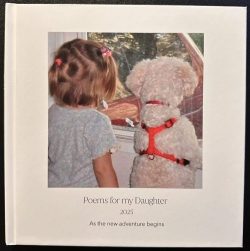
Poems for my daughter
My DIY book cover

I gave her a book of personal poems I had written about her to mark this significant transition in her life out of high school into university. Each piece was inspired by words I had collected about her from loved ones. At my request, they had sent me three words they think of when the think of her. I took them all and wrote some musings in hopes they would encourage, inspire, comfort or even spur a giggle from my youngest.

None of these poems came from a kit at Michaels or the Dollar Store. All of them came from me.

Tears ran down her cheeks as she read the pages. My heart filled.

That’s when I realized writing is my DIY, and damn, I am talented, thoughtful and creative!

I had created similar books for her two older sisters when they graduated. Each with their own twist, and their reactions equally filled my heart.

Over the years, I’ve written random poems and musings for many life moments for people I love: retirements, goodbyes, thoughts for a dying friend, my dad’s 90th birthday. I even did one for National Donut Day once. So fun! I do it because I love it and it means something to me. In turn, I also hope my words might mean something to others too – at the best of times, maybe they even get a laugh. (I’m no joke teller in real life, but sometimes I’m funny on paper 😊)

So, as it turns out, my DIY DNA isn’t half bad and I can hold my own against the likes of Holly and Leah.

Tell us how you DIY your writing and what it means to you.

1 Comment

Filed under Feel good, Inspiration, Life and stuff, Motivation, poetry, Trials and Tribulations

A meditation in three words

I have some big creative plans for 2025.

I’m working on a short story collection, with a goal of drafting one story every month. The Restless Writers are working on a collaborative project – which Beckie mentioned a few months ago – that will have a lot of moving parts and ambitious deadlines. I have a new non-fiction project waiting in the wings, as well as some non-writing related plans too.

I’m excited to work towards my goals, and they’re important to me. But like a lot of the world, I feel like I’m teetering on the edge of chaos. How can I intentionally create space for pursuing my writing when it feels like I’m losing control? How can I keep moving forward when the work feels like I’m swimming through molasses? How can I support my creative and mental health in an already full and hectic life?

What helps me is a three-word mantra: Discipline. Patience. Joy.

Here’s what these words mean to me.

Discipline

I’ve come to accept that, for me, a daily writing habit isn’t realistic. I have a full-time job and do freelance work on the side, so it’s not feasible to find an hour to write every single day. What I can do is plan writing blocks in my weekly schedule when it makes sense for me. Sunday mornings, for example, work very well. Mini-DIY writing retreats are another tool I use. The discipline part kicks in when I commit to those writing blocks or retreats and use my writing time effectively.

(Not a write-every-day person? Feel better about it with the idea of “binge writing,” which I learned from Allison K Williams in this blog post.)

Showing up for other people is another part of my creative discipline. The monthly(ish) Restless Writers meetings are a big part of that. I also offer support to a small circle of people who are working towards creative goals and need the help of an accountability partner. When I show up to co-work with them, I’m also showing up for myself.

Most days, I struggle with focus. And there’s nothing like the fidgets to disrupt one’s creative efforts. So, this year, I’m banning the disruptors – those things that pull me out of creative flow. I’ve deleted TikTok (which I should have done eons ago, honestly). I’ve muted social media notifications. I’ve silenced the siren call of books to be read and jigsaw puzzles to be completed by moving them to a different room. Out of sight, out of temptation, right?

I’ve also taken steps to make it as easy as possible to transition into writing mode. Check out my previous posts about creative readiness (part 1 and part 2) if you want to hear how I’m setting myself up for creative success.

Patience

Where the word discipline feels somewhat sterile and harsh, patience feels like grace.

Creative work takes time, especially if you’re pursuing bigger goals, like a novel. With generative AI all around us, promising instant creative gratification, it can be hard to pull on the reins and settle into a rhythm of doing the time-consuming work. I have to remind myself that my writing goals won’t be achieved in one day – or heck, even in one week – and that’s okay. My slow and bumbling human brain is creating worlds, inventing people, and imagining love and disaster. Isn’t that beautiful?

Patience is also about knowing that my creative work will be there even if I have to step away from it. Life happens, and you might experience things that throw you off your creative game. I’ve had some setbacks already this year. Work got busy early. I had a monster freelance project that never seemed to end. The US election results gave me creeping, swirling, can’t-sleep-at-night anxiety. And last week, I said goodbye to my darling tortoiseshell cat, Mary Piper, who had been my companion for the last 14 years. Today was the first day I’ve felt like getting back to my writing. And you know what? The creative spark and the drive were still there. The story still called to me. So, I poured a coffee, put on some focus music, and got back to it.

This is Mary Piper, and one of her gazillion toys.

Joy

The third facet of my mantra is a gift to my creative self, a way of refilling my well and helping me feel connected to people and beauty around me. Frankly, joy has been hard to come by recently. There’s a lot going on – in my life, in the world – that makes joy seem elusive, like a shy fox in winter, or a sunrise hiding behind the morning fog. It can also be hard to recognize joy when you crash into it.

For me, joy feels like the hum of creative connection, the quiet of being immersed in nature, the exhilaration of moving my body, and the pleasure of interacting with art.

This year, I’m making the experience of joy a proactive exercise.

I’m seeking out and attending events, like an author reading at the library or an Alice in Wonderful exhibit at the Royal Botanical Gardens. I’m waking up early and walking to the frozen and glorious lake. Those books and puzzles I relegated to another room for the sake of discipline? I’m savouring them when I’ve finished my writing for the day. These moments are me welcoming and pursuing joy in my everyday life.

Discipline. Patience. Joy.

I breathe deeply and hold these words in my consciousness as I get ready in the morning. I contemplate them, written on the whiteboard in my study, throughout the day. I whisper them to myself when I get frustrated or depleted or sad. I re-visit them at night, to remind myself that I’m nurturing my creative self in ways that work best for me.

Do you have a mantra or a special word for 2025? I’d love to hear what it is and what it means to you.

Maria

2 Comments

Filed under Life and stuff, Motivation, Trials and Tribulations

Getting Tactile: my spine poem

At a workshop Maria and I took a few months ago, we were challenged / encouraged / prompted to consider creating a “spine poem” as a possible, think-outside-the-box way to write poetry. We have since challenged each other to create our own.

You’ll find Maria’s at the end of the post she wrote about the workshop.

Beckie shared hers last month.

My turn.

I rummaged around my house, pulling titles from from my bedside table, the basement bookshelf, the living room end table. Books I haven’t looked at for a loooong time.

I played with the order, added titles, took some out, put them back in. Set up the photo. Changed the set up. Changed it again. Took stuff out of the background. Re-positioned.

It was tactile, visceral, energizing, playful creativity.

I highly recommend it.

Women who run with the wolves
Eat mangoes naked
Color me HAPPY

Untamed, big magic
Daring greatly

A course in
MIRACLES

2 Comments

Filed under Uncategorized

Building creative readiness – Part 2: Your creative mindset

In my last post, I talked about the concept of creative readiness and what that means in terms of your physical environment: your writing space, your writing tools and technology, and the things you need around you to be your best creative self.

But your physical environment is only one part of the picture. Your mindset plays a huge role when it comes to being focused, productive, and creative.

For many writers, feeling inspired and “in the mood” to write is the challenge. But as Jack London famously said, “You can’t wait for inspiration. You have to go after it with a club.”

(Actually, he wrote, “Don’t loaf and invite inspiration; light out after it with a club, and if you don’t get it you will nonetheless get something that looks remarkably like it,” which I think is much more poetic.)

This echoes that quote from Ivan Coyote in my previous post, about being “actively engaged in the creative practice.” For them, lighting out after inspiration and creativity involves self-discipline, walks, and hot showers.

As a writer with a day job, I don’t have the luxury of waiting around for my muse to make an appearance. I need her to show up in those 30-minute increments I have cleared out of my day to write. Like, at the snap of my fingers.

Basically, I have to be my own muse, or write without one.

Real picture of me and my Muse collaborating on a story.

Creative readiness, when it comes to mindset, looks like this:

  • maintaining a full creative well that you can draw from;
  • being resilient and able to overcome creative challenges like writer’s block or burnout; and
  • having the skills to step into creative mode when it’s time to write.

I asked the other Restless Writers how they refill their creative wells.

For Beckie, connection nourishes creativity. She builds creative energy by “spending time with other creatives, like my Restless Writers.” In addition to our meetings and retreats, Beckie says that when she needs some help getting creative, she looks up. “The night sky is an inspiration.”

Andrea too finds that connecting with other artists and writers helps. Besides the inspiration she gets from the Restless Writers, she engages with creative works to get her ideas going. She says she will “read a great book. Go to the theatre to see a play or musical. Watch a great actor in a movie.” Andrea has a performance background (plus she’s an amazing trainer and facilitator), so it’s no surprise that theatre, singing, and dance parties with her daughters keep her feeling her creative best.

“Reading a lot of fiction is great,” echoed Sharon. “I get little pieces of inspiration from that—whether it’s from a piece of dialogue or an interesting story choice.”

For me, connecting with the Restless Writers (and other writers and creatives) and pushing myself out of the inertia of routine with challenges makes me feel pumped about writing. Beyond writing, I enjoy making digital art and taking photos of things that strike me as visually interesting. When I’m doing something like building out graphics for social media, I get to engage a different part of my creative brain. There are usually words involved, so the interplay of language and graphic arts intrigues me as well.

Whether or not you believe writer’s block is a thing, the struggle to write well—or even to get started—is something that hits us all at some point. My struggle is usually with writer’s jam. That’s when I have so many projects on the go, I pinball between priorities and can’t make meaningful progress on any of them, so I avoid my writing altogether. It’s brutal. I know focus and monotasking is the way to go, and that’s something I have been working on recently with pomodoros, co-writing sprints, and allowing myself to go as slowly as possible without actually stopping.

Andrea’s approach to tackling writer’s block starts with mindfulness. “I start by just breathing in and releasing tension, and then I free write—what I see/hear/smell, what’s in my head, what’s in my heart, with no judgment. Just words on a page. And I wait for my muse to return. She doesn’t always, and I’m left with captured random thoughts. When she does return, I welcome her in and try to open to the gifts she is offering.”

Sharon addresses writer’s block by switching things up. “In the last few months, I’ve been trying something new where I dictate a first draft of a chapter into my computer or phone. I try to go through it in one go, even if I am tripping over my words. The dialogue is choppy and a lot of the words are misspelled but it helps me get the structure of the chapter down. It takes the pressure off of staring at a blank page.” (I’m definitely going to try this, Sharon!)

Burnout can also affect creative readiness. Beckie says she experiences burnout “usually after completing a large project. Or even in the months prior to completion. It can feel like such a grind to get to the end, while, in reality, there is no end.” She focuses on other creative projects to help with recovery—things like painting, gardening, reading, or astrophotography.

Andrea says she can get “mind burnout,” where she’s overwhelmed and can’t do any kind of work, including writing. When this happens, she says she tries “to take time to ‘not do’ and just be. It could be days, weeks, or months, but my need to create always returns.”

I’ve had this experience too. I can be “away” from my writing for long stretches, but something—a Restless Writers meeting, a prompt, a new idea, a fresh take on an old story, or just the urge to bring something to life on paper—brings me back.

I wish I had a cheat code that I could apply to instantly switch to creative mode when I sit down to write. But I know there is no hack. It comes down to cultivating a regular creative habit, nurturing your creative self, and filling your creative well so you can step into writing mode as easily as possible.

In many ways, writing sets up a self-sustaining feedback loop. The act of writing itself is what kickstarts creativity and keeps the momentum going.

Once you start writing, you are creating the mindset and conditions to…keep writing.

As Beckie told me, “For me, creative readiness generally happens after I start a project and not before.”

Luckily, the Restless Writers support each other in sticking to our writing projects and nurturing our creative abilities. “They cheer me on,” said Andrea. “They offer smaller goals to help motivate me; remind me that my writing matters to them. I am grateful for them and their patience and acceptance.”

Thanks to my restless crew for sharing their thoughts on creative readiness and mindset. It’s been interesting to see how each of us approach our work and keep moving forward.

We’d love to hear from our readers too! What does your creative mindset look like? How do you stay resilient in the face of writer’s block and burnout? What habits help you “light out after inspiration”?

Maria

1 Comment

Filed under Inspiration, Motivation, Trials and Tribulations

Today’s Poetic Prompt

This post is inspired by Maria. She has been writing up a storm these days and keeping us on our toes. A woman on a productivity mission! Maria prompted us back in May with her book spine poem, and I thought I’d give it a whirl.

The Island of the Day Before

Quiet, simple sabotage.

The gifts of imperfection:

illusions, nostalgia, pandemonium.

What’s left of me?

The dreamer.

Andrea, Sharon, I believe it’s your turn.

BJas

3 Comments

Filed under Inspiration, poetry

Building creative readiness – Part 1: Your physical environment

According to celebrated author and performer Ivan Coyote, “You have to be actively engaged in the creative practice for the creativity to hit you” (Globe & Mail, August 7, 2023). They credit self-disciple, nature walks, and hot showers to their success. Coyote strongly believes that you have to put in the work to be prepared to be creative. That way, you’re ready when inspiration hits.

I think of this as creative readiness – an intentional way of removing any friction between you and your writing practice. It’s an approach that clears out the excuses and signals to your creative muscles that it’s time to write.

Creative readiness has two dimensions: your physical writing environment and your creative mindset. Being prepared to be creative means shoring up both of these dimensions. In practice, creative readiness is a series of individualized actions or processes that mark the transition into writing mode, and a way of preparing yourself mentally to make that transition.

I wondered what other writers thought about creative readiness, so I asked my fellow Restless Writers to weigh in. They had a lot to say – so much in fact, that I’m splitting this blog post into two parts.

In this first part, let’s dig into how the Restless Writers set up their physical environments to work on their creative tasks.

Space to let the words flow

A writer needs space. A place to build worlds, invent characters, concoct plots, converse with their muse, and do battle with their inner critic. Virginia Woolf famously said that women writers needed “a room of one’s own” (literal and metaphorical) in which to write. Ray Bradbury wrote his first novel on a typewriter he rented for ten cents an hour in the basement of UCLA’s Lawrence Clark Powell Library. Edith Wharton wrote from her bed.

I asked AI to create an image of the perfect writer’s office. Here’s the result:

I mean… That looks pretty perfect to me. (The Edison lights and cosy blanket? Love those details!)

In reality, there is no universal “perfect” writing space – it is personal to each writer.

Beckie, a Restless Writer with an enviable backyard, has a dedicated writing shed – but it’s weather-dependent. “Ideally, I write in my writing shed. This works best because there are no distractions, except weather at times when it can get too hot or too chilly. I dream of a mini woodstove in there, with space for a tea pot.” When the shed isn’t an option, she makes do with her dining room table. Beckie is currently editing a memoir.

Cute shed, Beckie!

Andrea has a self-described “backyard oasis” at her home, complete with multiple writing spots and a pool if she needs an active break. Her space is weather-dependent as well. If she’s forced inside, she opts for the living room couch. Wherever she is, she needs a bit of nature. “I look for a spot that is comfortable and full of light; under trees, or where I can see them.”

Staying mobile means Andrea is ready to write when inspiration hits. Sharon, who’s working on a mystery/thriller novel, likes to mix up her writing spots too. “I usually write sitting up in bed against the headboard with my laptop on my lap (obviously) and my notes spread out around me,” she says. “If I’m at the library, I go for the comfiest chair I can find.” Sharon finds sitting at a desk to be too formal.

Like Beckie, I have a writing space all to myself, but it’s also my home office. I have a work-from-home day job, so my 9-to-5 is the same space as my 5-to-9. On the plus side, a dedicated office means I don’t have to fight for space or negotiate with family members for a little quiet time. There’s room enough for my books, writing supplies, files, and two desks. I can close the door and focus on my work whenever I want.

My creative readiness struggle is transitioning from work-Maria to creative-Maria without physically leaving my office. I’ve started to venture out of my formal office and – like Beckie – set up on the dining room table so I can step purposefully into the writing zone.

Technology, talismans, and snacks

The physical writing space includes all the things we need around us to write. That can look different for everyone, but the basic categories are writing implements/technology, writing supports, sustenance, and ambiance.

Sharon gets back to basics when she writes. “I’ve usually got a glass of water beside me on the nightstand and a little bowl of some nibblies – M&Ms, almonds, chips, they all work. I’ve always got the outline for my novel nearby to remind me where I’m headed.”

Andrea’s setup is also pared down: she just needs a notebook and a pen with blue ink, with “candles and calm.”

Beckie is the only RW who mentioned music. She likes to write with “a chill playlist – something ambient.”

As for me, I need my laptop or lined notepaper and a good pen (I write longhand when I’m brainstorming or outlining); my hard-copy story notes and outline; coffee with plenty of milk; and quiet. Those are the absolute must-haves for me to write.

I do appreciate some technological supports. I prefer to keep my phone out of my line of sight, but I do use the timer for writing sprints. Music can get my creativity going, so I sometimes have a classical playlist or an instrumental soundtrack playing. But music with lyrics is too distracting for me. I am experimenting with a talisman – I’m not a woo-woo person but I do believe in the power of rituals. I found a hunk of clear glass on one of my waterfront walks, and I’m placing it near my laptop as a reminder to focus my writing energy.

Making a “creatively ready” writing space

Here’s what I’ve learned about preparing one’s physical space to support a regular writing practice:

  • Identify needs versus wants. While having the perfect physical writing space is every writer’s dream, it won’t be the reality 100% of the time. When it comes down to it, all that any writer needs is a comfortable place to write and the materials you need to be productive and creative. Everything else is gravy. (Like those Edison lights or the soundtrack to Interstellar.)
  • Know yourself. Some writers do their best work at a bustling coffee shop, while others need quiet and privacy to get going. Note where you’ve been productive in the past and do your best to replicate those conditions.
  • Have options. Less-than-ideal conditions can give you a great excuse to skip out of your writing time – like if a heat wave is keeping you from writing in your she-shed, you’re out of M&Ms, or someone stole your favourite seat at Starbuck’s. Have a plan B, even if it’s not ideal.
  • Don’t rely on perfect conditions to write. Waiting for conditions to be just so or spending too much time creating an idyllic space can lead to not doing the work. If there’s anything you should strive for, it’s the ability to build a regular writing habit. I think Sharon said it perfectly: “Don’t overthink creative readiness too much. Have confidence in your ability to be creative at any given time. Most of the time I am just diving blindly into creative projects, knowing that I’ll get where I want to go at some point because I have shown myself many times before that I can.”

Bottom line, creative readiness is about balancing the conditions that help you write at your best with the very minimum you need to put the work in, plus the creative confidence to push on.

In the next part of this post, we’ll talk about the mental and psychological side of creative readiness, and how the Restless Writers get into the writing mindset.

For fun, I asked AI to adjust that image of the perfect writer’s office to include a timed device that would keep a person locked in their chair so they don’t get distracted. The image looks pretty unhinged, but someone should invent this.

Take my money!

Until next time,

Maria

2 Comments

Filed under Motivation

Curious creativity

Recently, I was chatting with a writer I know who is results-oriented to the extreme. He proceeds by tackling and completing tasks in a linear, structured way. He swears by detailed outlines, story-arc schematics, and rich character tables.

He confessed that he was dealing with writer’s block.

“I don’t get it,” he said. “I know exactly where my novel is going, and how my main character will overcome a critical internal conflict. I even have the final dramatic scene laid out in bullet points! But I can’t seem to get writing. I’ve set goals for myself, but all my deadlines have flown past—whoosh! It’s totally frustrating.”

Sounds like it’s time for my friend to try a curiosity challenge.

A curiosity challenge is a mindset technique — suggested by one of our blog readers — that can help you get out of a writing slump. I’m trying it myself this month, to help me address creative anxiety, re-kindle my passion for writing, and get back into a regular writing practice.

All that a curiosity challenge involves is the reframing of a goal statement into a curiosity question. It’s simple and powerful. Instead of setting a rigid word-count goal or deadline for yourself, try turning it into an experiment.

Frame your experiment with phrases like: “I’m curious if…” or “Is it possible to…” or “I wonder if…” or even “Wouldn’t it be cool to…”

Here are some examples:

Instead of saying this……try this.
I have to wake up extra-early all week so I can meet my word-count goal!I’m curious if I can get up an hour early every day this week and write before my kids get up.
The only way I can make this submission deadline is if I write the whole thing this long weekend!Is it possible to write 10,000 words over one long weekend?
I have to focus on this chapter and finish it before I can move on with my novel!I wonder if I could write a scene from my main character’s dog’s perspective?
My revised chapter 1 is due to my writing group in less than a month!Wouldn’t it be cool to share a revised draft of chapter 1 with my writing group next month?

This approach takes the fear of failure out of the equation. If you’re anxious about not being able to achieve a writing goal or getting derailed, remove the anxiety by eliminating the high-pressure stakes.

If you’re finding yourself stuck or blocked or bored, bring this curiosity perspective to your writing. Don’t plan; play. Be bold. Explore a possibility. Do something new just to see if you can. Broaden your understanding of what you can achieve by trying something out.

Be ever-curious and challenge yourself with a not-so-serious approach. You’ll be surprised by how this simple hack can give your creativity a kick-start.

Are you going to give the curiosity challenge a try?

Maria

P.S.: June 2024 marks the 15th anniversary of the first blog post we ever published as the Restless Writers. (!) This is a super-exciting milestone and we are planning some fun ways to celebrate. Thanks to our readers for being here, and kudos to all our fellow writers who are on their own creative journeys.

1 Comment

Filed under Motivation, Trials and Tribulations, Writing supports

The possibility of poetry

Fellow Restless Writer Andrea and I had signed up to attend a virtual workshop hosted by our local library called “Prompts to Find Your Inner Poet.” I almost didn’t join in, for two reasons: one, I am still working to get over my prejudice against poetry; and two, the workshop was being led by Lynda Monk, a coach, speaker, facilitator, and author who is passionate about journalling – and I hate journalling. (Raise your hand if you’ve ever felt traumatized by Julia Cameron and her morning pages.)

Fortunately, I gave myself a rousing pep talk, convinced myself that it was only for an hour, grabbed a bottle of wine, and headed over to Andrea’s house, so we could attend online together.

The workshop, held last week, was well attended – about 35 people – and Lynda gave a gracious, welcoming, and warm introduction to the workshop. She told us there would be writing exercises (which I was eager to dig into) and that “we are all poets in some way.”

If I had expected the event to be cringey, it wasn’t. Lynda opened by asking us to reflect on “what is poetry?” She described a type of literary expression that is resonant, captures beauty and emotion, helps us feel “aliveness” and connection, and speaks to the “unspoken”: the “spaces in between and around experiences, thoughts and feelings.” She outlined a plain language understanding of poetry that was immediately accessible.

Lynda shared one of her favourite poems – “Wild Geese” by Mary Oliver – and asked us to reflect on what stood out for us in the poem. A word, a phrase, a feeling? She shared that the poem evoked a sense of quiet, and that everyone needs to be able to access that kind of quiet in order to write.

She returned to this concept later in the session when she talked about the white space on one of the presentation slides. “Our creative selves need white space, where we can recognize what we have within our hearts to say.”

Throughout the session, Andrea and I would make little affirmative noises in response to some piece of insight that Lynda shared about poetic language. I found Lynda’s approach to talking about poetry, and encouraging each of us to explore new poetic prompts, to be the opposite of cringey. She was engaging, positive, non-critical, practical, and inclusive.

One takeaway for me was what Lynda had to say about the transformative effects of poetry. To paraphrase, poetic writing can transform what we’re feeling into something else (e.g. writing about a negative experience can turn it into a positive one), and poetic writing can transform ourselves, by altering our perceptions about our own experiences and emotions.

The writing exercises were intriguing and fun – Andrea and I agreed we should share the prompts at a future Restless Writers’ meeting.

  • Take the first line of your favourite poem, and use it as a prompt for your own poem. Lynda used Emily Dickinson’s “I dwell in Possibility” as the line prompt.
  • Use the structure of an existing poem as a template for your poem. “Otherwise” by Jane Kenyon was the perfect prompt to have us imagining our own alternate lives.
  • Cut words out of a magazine or newspaper, and paste them into poems in different shapes. (Ahem, an idea for the next Restless Writers’ holiday craft night?)
  • Create a “book spine poem.” This was another exercise Lynda encouraged us to try on our own time – you take books from your shelves, and make a poem out of their titles. Mine is below.

Principles still missing.
How did that happen?
The novel cure underland, surrounded by idiots, sediment in streams.
Do not disturb the big thing.

I’m thankful I talked myself into joining the workshop, and I’m thankful for Lynda’s generous and gentle approach. It opened up something in my imagination and in my writing that I might have been repressing. I’m looking forward to exploring more poetic writing this spring.

Maybe I’ll even give journalling another go. But no promises.

Which of the poetic prompts above will you try?

Maria

PS: Learn more about Lynda here.

7 Comments

Filed under Inspiration, poetry

Do something scary

benjamin-wedemeyer-9FMDYPCv8mQ-unsplash

I have jumped in something new. Something exciting. Something scary. And I LOVE it.

It’s scary because it’s a re-entry into a world I have been away from for the past nine-years. It’s also scary because I’m allowing myself to be exposed and vulnerable with a group of people and a director I don’t know, as we explore the art of solo theatre together.

This is exactly what I’ve needed. I’ve been writing my friggin’ play for years now – while balancing kids and a full-time job (you know the drill). I’ve been making progress, but for a while, it’s been feeling like the show has been missing a certain je ne sais quoi (and/or I’ve been hesitating putting it out there for fear of judgment).

It got to the point where my fellow Restless Writers said, “Um, Andrea, what is going on with your play. Are you going to workshop it any time soon or something?” Followed up by my husband a few days later saying “Yeah, what is happening with your play?”

So, with a good smack on the butt from my accountability team, I knew I would have to shake things up if I was going to gain any momentum.

Well, momentum I am gaining, my friends. I am working with a master in one-person theatre – Tracey Erin Smith. She is the Artistic Director of Soulo Theatre, the creator of hit shows, and the writer and performer of many of her own solo shows. She’s brilliant, insightful and visionary, and she’s taking no prisoners!

If I wanted something to rock my world, this is it, on so many levels. She’s guiding our group of seven to each create our own 10-minute autobiographical show. It’s writing, acting, playing, soul-searching, self discovery, with what feels like a bit of therapy tied in altogether. And it’s not for the faint of heart. If you’re not all in, don’t bother.

But that’s what makes it magical. We’re a group of committed individuals who want to go on a totally new journey, doing something we’ve never done before, and see where it can lead us and how it will change us. This is why I LOVE theatre. It’s always a stretch. It’s always uncomfortable. It always changes me a little bit.

I had been stuck in my writing because I wasn’t stretching. I was comfortable and staying safe. And we all know good writing – and good theatre – doesn’t work if it’s safe. That’s our job as artists. To push boundaries…but we can’t push them if we’re not pushing ourselves.

So far, over the past four weeks, I’ve been nauseous, shaky and exhilarated. I feel alive and present in a new way, and it’s making me a better writer and performer FOR SURE!

So, your turn. Stop for a second and think. Are you a little stuck or maybe a bit too cozy in your routine or your writing? Are you pushing yourself creatively? Have you done anything recently in your own life to stretch yourself? Is there anywhere that you feel “all in?”

Find something that scares you and go for it. Jump in. Your readers will thank you.

1 Comment

Filed under Inspiration, Life and stuff, Motivation

Your writers’ retreat guide

quote calligraphy under cup of lemon tea

Photo by Studio 7042 on Pexels.com

For weeks, I had been counting down the days and hours to my trip down the QEW in my black Yaris, to Niagara-on-the-Lake, mounting over Lake Ontario on the Skyway bridge thankful the winds weren’t threatening and the bridge was open. I passed the usual industrial parks on my right and the Stoney Creek Furniture warehouse from where I dream to one day afford a couch. Eventually, the stores changed and I saw Magnotta Winery and signs for Niagara wine tours. I turned onto highway 55, past Trius Winery, Pillitteri Estates, Stratus Vineyard. Oh yes. I was close and I knew a glass RELAX Riesling awaited me. I envisioned the blue bottle catching the sun from the window and my shoulders relaxed. I looked at my computer bag on the passenger seat. The first printed shitty first draft of my play slept there. She’d been beckoning me to get out and run amok with her – soon, my sweet. Very soon. And then I pictured the two smart, fun women and cheerleaders I was about to spend my long weekend with, who I’m sure already had a glass in their hands. I grinned. Life was as it should be. I was ready to let go of the usual daily stuff and dive into another writing retreat. We’ve got a number under our belt now and the system is honed. I knew a great, productive weekend awaited.

So let me give you a guide to a great retreat and share some key principles we live by:

  1. Start with good snacks, food and drink. This one has never been a problem for the Restless Writers. We usually have a signature cocktail each retreat, WAAAY too many Pringles and a fridge that is still too packed by the last day. We’re slowly learning realistic quantities of food to bring, but at least we know we’ll be well fed. We are also budget and time conscious. So we share meal prep (each taking charge of one) and rarely go out because it’s expensive and takes away valuable writing time. Go with what works for you, but whether you go Skip the Dishes, potluck, or venture out for meals, plan it ahead of time, so you’re all on board.
  2. Bring your comfies. This means moccasins for me, fuzzy slippers for Sharon, an electric blanket for Beckie, and Prosecco for Maria – for that girl, comfort is defined by a glass of the bubbly in her hands, no matter the hour! Ego is left at the door for RW and you’ll find no fashion shows at our retreats.
  3. Have a kick off and write down your goals. We like starting our retreats by having an activity to shift our minds into creative mode. Keep it simple and consider a writing exercise or guided meditation, or something to open your mind and help release fears and blockages. We also always discuss and write down our goals for the weekend. It forces us to focus in and remember this isn’t just a girls’ weekend away. We’ve got work to do and we’re here to help each other get there. Writing it down makes us accountable to each other.
  4. Have your materials ready.  Bring your favourite pen, lap desks, sticky notes, markers, cue cards, extension cords, earphones, whatever you need to be productive. For us, these are precious weekends, so we don’t want to waste them not having what we need to get busy.FullSizeR001(1)
  5. Don’t over plan or over schedule. We’ve sometimes done this in the past: had a strict agenda detailing every hour, invited a yoga instructor to run a class for us, booked a few wine tours. We’ve relaxed a lot over the years and try and let each retreat flow as it needs to, which leads me to…
  6. Respect each other’s needs and be honest. Everyone’s creative process is different, and as a group you need to both recognize that and respect it. At the same time, each person needs to feel safe to be honest with what that means for them. The writing is about you in the end. So speak up for what you need, and give space to others at the same time. As an example, this past retreat, I felt in my zone and was happy in my pajamas indoors all day. Sharon needed to get herself outside and walking. We know we don’t have to do everything as a group. We are our own guides in our work and we appreciate that in each other.
  7. Be kind to yourself. The purpose of a retreat is to give you time and space for your writing project. Give yourself the freedom to explore. Let go of judgment. Don’t worry if you’re “doing it right,” nor compare what you’re doing with the others in the group. They’re slogging it out in their own way. And if you don’t meet your goal at the end, consider that maybe you set the wrong goal, or if you’re frustrated, figure out if you spent your time the way you wanted to, or were more focused on mixing drinks for everyone, procrastinating. Either way, take stock and learn from it. It’s all good.
  8. Do a postmortem. We’ve gotten better at our retreats because just before we leave, we go for coffee and do a final check in. Did we like where we stayed? Was the space good? Did we like our kick-off meeting exercise? What do we need to bring next time that we forgot? Was the price right and the time of year good? Do we want to have a more formal agenda? Take notes and learn each time how your group ticks.

As I reflect back on our last retreat, I guess the last lesson is: Be ready for anything. I mean anything. Because just when you think you’ve gotten used to being down from the usual four to three because one of you is across the country, that fourth girl just might shock the shit out of you and show up at your doorstep!

You just never know what a retreat will bring. Have fun and happy writing!FullSizeR

1 Comment

Filed under Group meetings, Motivation, Organization, Retreats and conferences, Writing ideas