
According to celebrated author and performer Ivan Coyote, “You have to be actively engaged in the creative practice for the creativity to hit you” (Globe & Mail, August 7, 2023). They credit self-disciple, nature walks, and hot showers to their success. Coyote strongly believes that you have to put in the work to be prepared to be creative. That way, you’re ready when inspiration hits.
I think of this as creative readiness – an intentional way of removing any friction between you and your writing practice. It’s an approach that clears out the excuses and signals to your creative muscles that it’s time to write.
Creative readiness has two dimensions: your physical writing environment and your creative mindset. Being prepared to be creative means shoring up both of these dimensions. In practice, creative readiness is a series of individualized actions or processes that mark the transition into writing mode, and a way of preparing yourself mentally to make that transition.
I wondered what other writers thought about creative readiness, so I asked my fellow Restless Writers to weigh in. They had a lot to say – so much in fact, that I’m splitting this blog post into two parts.
In this first part, let’s dig into how the Restless Writers set up their physical environments to work on their creative tasks.
Space to let the words flow
A writer needs space. A place to build worlds, invent characters, concoct plots, converse with their muse, and do battle with their inner critic. Virginia Woolf famously said that women writers needed “a room of one’s own” (literal and metaphorical) in which to write. Ray Bradbury wrote his first novel on a typewriter he rented for ten cents an hour in the basement of UCLA’s Lawrence Clark Powell Library. Edith Wharton wrote from her bed.
I asked AI to create an image of the perfect writer’s office. Here’s the result:

In reality, there is no universal “perfect” writing space – it is personal to each writer.
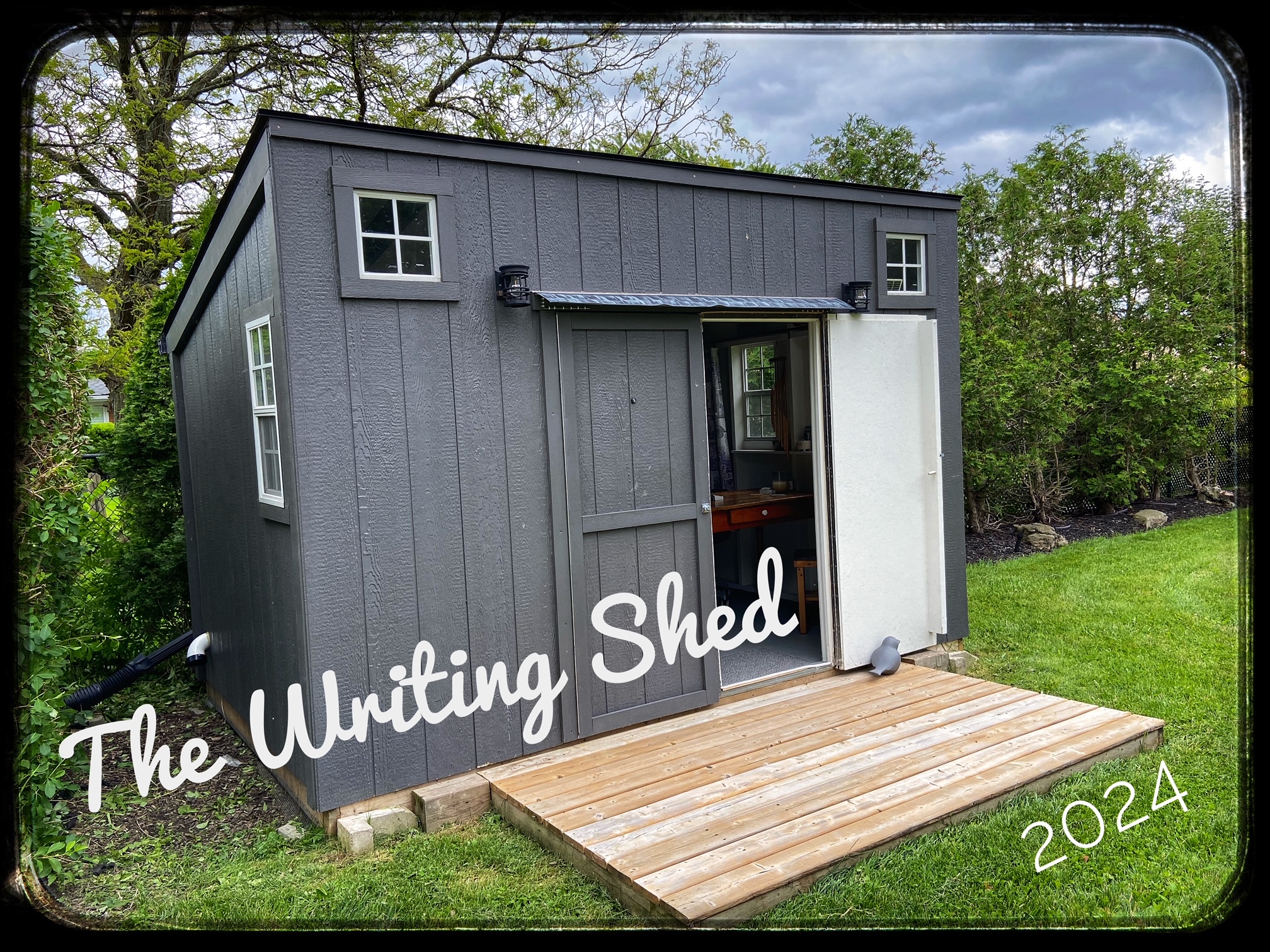
Beckie, a Restless Writer with an enviable backyard, has a dedicated writing shed – but it’s weather-dependent. “Ideally, I write in my writing shed. This works best because there are no distractions, except weather at times when it can get too hot or too chilly. I dream of a mini woodstove in there, with space for a tea pot.” When the shed isn’t an option, she makes do with her dining room table. Beckie is currently editing a memoir.
Andrea has a self-described “backyard oasis” at her home, complete with multiple writing spots and a pool if she needs an active break. Her space is weather-dependent as well. If she’s forced inside, she opts for the living room couch. Wherever she is, she needs a bit of nature. “I look for a spot that is comfortable and full of light; under trees, or where I can see them.”
Staying mobile means Andrea is ready to write when inspiration hits. Sharon, who’s working on a mystery/thriller novel, likes to mix up her writing spots too. “I usually write sitting up in bed against the headboard with my laptop on my lap (obviously) and my notes spread out around me,” she says. “If I’m at the library, I go for the comfiest chair I can find.” Sharon finds sitting at a desk to be too formal.
Like Beckie, I have a writing space all to myself, but it’s also my home office. I have a work-from-home day job, so my 9-to-5 is the same space as my 5-to-9. On the plus side, a dedicated office means I don’t have to fight for space or negotiate with family members for a little quiet time. There’s room enough for my books, writing supplies, files, and two desks. I can close the door and focus on my work whenever I want.
My creative readiness struggle is transitioning from work-Maria to creative-Maria without physically leaving my office. I’ve started to venture out of my formal office and – like Beckie – set up on the dining room table so I can step purposefully into the writing zone.
Technology, talismans, and snacks
The physical writing space includes all the things we need around us to write. That can look different for everyone, but the basic categories are writing implements/technology, writing supports, sustenance, and ambiance.
Sharon gets back to basics when she writes. “I’ve usually got a glass of water beside me on the nightstand and a little bowl of some nibblies – M&Ms, almonds, chips, they all work. I’ve always got the outline for my novel nearby to remind me where I’m headed.”
Andrea’s setup is also pared down: she just needs a notebook and a pen with blue ink, with “candles and calm.”
Beckie is the only RW who mentioned music. She likes to write with “a chill playlist – something ambient.”
As for me, I need my laptop or lined notepaper and a good pen (I write longhand when I’m brainstorming or outlining); my hard-copy story notes and outline; coffee with plenty of milk; and quiet. Those are the absolute must-haves for me to write.
I do appreciate some technological supports. I prefer to keep my phone out of my line of sight, but I do use the timer for writing sprints. Music can get my creativity going, so I sometimes have a classical playlist or an instrumental soundtrack playing. But music with lyrics is too distracting for me. I am experimenting with a talisman – I’m not a woo-woo person but I do believe in the power of rituals. I found a hunk of clear glass on one of my waterfront walks, and I’m placing it near my laptop as a reminder to focus my writing energy.
Making a “creatively ready” writing space
Here’s what I’ve learned about preparing one’s physical space to support a regular writing practice:
- Identify needs versus wants. While having the perfect physical writing space is every writer’s dream, it won’t be the reality 100% of the time. When it comes down to it, all that any writer needs is a comfortable place to write and the materials you need to be productive and creative. Everything else is gravy. (Like those Edison lights or the soundtrack to Interstellar.)
- Know yourself. Some writers do their best work at a bustling coffee shop, while others need quiet and privacy to get going. Note where you’ve been productive in the past and do your best to replicate those conditions.
- Have options. Less-than-ideal conditions can give you a great excuse to skip out of your writing time – like if a heat wave is keeping you from writing in your she-shed, you’re out of M&Ms, or someone stole your favourite seat at Starbuck’s. Have a plan B, even if it’s not ideal.
- Don’t rely on perfect conditions to write. Waiting for conditions to be just so or spending too much time creating an idyllic space can lead to not doing the work. If there’s anything you should strive for, it’s the ability to build a regular writing habit. I think Sharon said it perfectly: “Don’t overthink creative readiness too much. Have confidence in your ability to be creative at any given time. Most of the time I am just diving blindly into creative projects, knowing that I’ll get where I want to go at some point because I have shown myself many times before that I can.”
Bottom line, creative readiness is about balancing the conditions that help you write at your best with the very minimum you need to put the work in, plus the creative confidence to push on.
In the next part of this post, we’ll talk about the mental and psychological side of creative readiness, and how the Restless Writers get into the writing mindset.
For fun, I asked AI to adjust that image of the perfect writer’s office to include a timed device that would keep a person locked in their chair so they don’t get distracted. The image looks pretty unhinged, but someone should invent this.

Until next time,
Maria
 Restless Writers
[…] my last post, I talked about the concept of creative readiness and what that means in terms of your physical […]
[…] as possible to transition into writing mode. Check out my previous posts about creative readiness (part 1 and part 2) if you want to hear how I’m setting myself up for creative […]